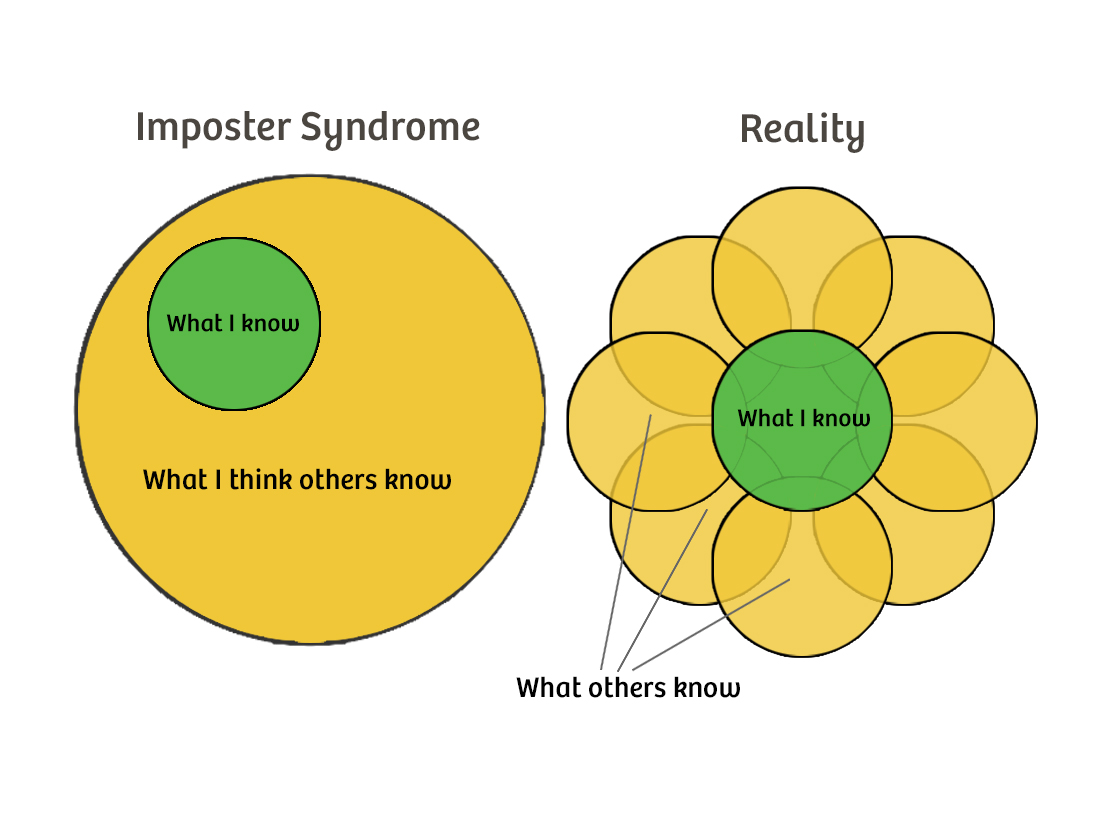
When I met with the Emboldly Fellows recently—a dynamic group of emerging leaders committed to making bold moves with heart—I invited them into a conversation many of us avoid: imposterism.
We didn’t just talk about “imposter syndrome” in the generic sense. We unpacked the types of imposters that live inside us—those inner voices that whisper we don’t belong, we’re not enough, or we’re just pretending. Naming those voices isn’t about shame—it’s about strategy. When we know which inner imposter we’re dealing with, we can call in the resilience tools needed to root ourselves again.
Types of Imposters
These aren’t diagnoses—they’re patterns we fall into when we doubt our worth or place in the room. Which of these sound familiar?
- The Perfectionist: If it’s not flawless, it’s not enough.
- The Expert: You’re afraid of being “found out” for what you don’t know—even when your lived experience is enough.
- The Natural Genius: If you have to work hard at it, you assume you must not be good at it.
- The Soloist: You believe needing help is weakness. You’ve got to do it alone.
- The Superhuman: Your value is tied to overperforming, overdelivering, and overextending.
Many of the Emboldly Fellows saw themselves in more than one type. And that’s the truth for many of us. These voices show up because we care. But left unchecked, they can block us from thriving.
🌳 How the Resilience Tree Helps
In The Resilience Tree, I offer a framework for navigating life’s hard moments and complex emotions—like imposterism—with curiosity, reflection, and replenishment. When the imposter voice gets loud, the Tree helps you get quiet enough to hear your truth again.
Here’s how each part of the Tree supports you:
- 🌱 Roots — Activities that replenish or ground you Imposterism thrives when you’re running on empty. Replenishing practices—like journaling, prayer, movement, creative time, or solitude—remind you that your worth is not tied to output. Stillness can silence the imposter.
- 🌿 Branches — People who believe in you, even when you don’t Who reminds you of your brilliance when you forget? When imposter thoughts try to isolate you, your branches hold you up. Reach out. Let their faith in you be the bridge back to believing in yourself.
- 🍊 Fruit — Knowing when to give and when to hibernate Some seasons call for harvest, others for rest. When you overextend yourself to “prove” you belong, you end up depleted. Imposter voices love burnout. But fruit grows best when the tree is nourished. Give from your overflow, not your survival.
- 🌎 Environment — Evaluating the ecosystem around you Sometimes it’s not you—it’s the room. Imposterism is often a byproduct of being in environments that weren’t built with you in mind. Pay attention to who and what surrounds you. Do you feel safe to show up fully? Your environment impacts your resilience.
✨ A Shared Reflection
During our session, one Emboldly Fellow paused and said, “I just realized how much energy I waste trying to earn a seat I already have.” That line struck a chord.
When you name the imposter, you take away its shadow. You stop shrinking and start rooting. You grow from a place of truth, not fear.
📖 Quote Inspired by The Resilience Tree
“When doubt starts to dig at your identity, remember this: trees don’t apologize for taking up space. They grow anyway. You’re not an imposter. You’re becoming.” — The Resilience Tree
✍🏽 Journey Prompt:
Grab a journal or open your notes app. Reflect on the following:
- Which imposter voice do I hear the most?
- What part of my Resilience Tree needs the most attention right now—my roots, branches, fruit, or environment?
- Who are three people who believe in me—and when’s the last time I let their words pour into me?
- What is one practice I can commit to this week to silence the imposter and strengthen my roots?
Bonus: Write down one affirmation you’ll speak over yourself the next time imposter thoughts arise. Example: “I am not here by accident. I have earned this space, and I continue to grow.”
___________________________________________________________________________________________________
References used for my presentation
- https://www.beyondpsychologycenter.com/therapy-for-imposter-syndrome
- https://health.clevelandclinic.org/a-psychologist-explains-how-to-deal-with-imposter-syndrome
- https://timsnewsletter.com/p/how-do-i-overcome-imposter-syndrome
- https://www.unlv.edu/news/release/break-out-your-social-circle-combat-impostor-syndrome-unlv-study-finds
- https://cco.contentmarketinginstitute.com/content-leader-impostor-syndrome/
- https://rockwoodleadership.org/imposter-syndrome-causes-burnout-and-isolation-but-how-do-we-stop-it/
- https://www.calm.com/blog/how-to-overcome-imposter-syndrome
- https://www.mcleanhospital.org/essential/impostor-syndrome
- https://www.healthline.com/health/mental-health/imposter-syndrome
- https://health.clevelandclinic.org/a-psychologist-explains-how-to-deal-with-imposter-syndrome
- https://www.obsidiancounseling.com/blog/2022/11/7/imposter-syndrome-and-how-to-stop-the-cycle-of-anxiety-depression-and-burnout
- https://www.unlv.edu/news/release/break-out-your-social-circle-combat-impostor-syndrome-unlv-study-finds#:~:text=What’s%20the%20difference%20between%20people,it%20to%20their%20own%20deficiencies
- https://hbr.org/2021/02/stop-telling-women-they-have-imposter-syndrome
- https://www.unlv.edu/news/release/break-out-your-social-circle-combat-impostor-syndrome-unlv-study-finds#:~:text=What’s%20the%20difference%20between%20people,it%20to%20their%20own%20deficiencies
___________________________________________________________________________________________________
If you would like to read more about the Resilience Tree Model visit: shaunatsobers.com/resilience or order the Book Resilience Tree: A Model for Women of Color and Those That Support Them by Dr. Shauna T. Sobers
#ResilienceTree #BoundariesAreFruit #Leadership #AthleteWellbeing #ProfessionalGrowth #PaceYourself #WhatIKnowForSure #YearOfYes.
**Drafting/editing assistance provided by OpenAI’s ChatGPT. The thoughts & stories are my own.