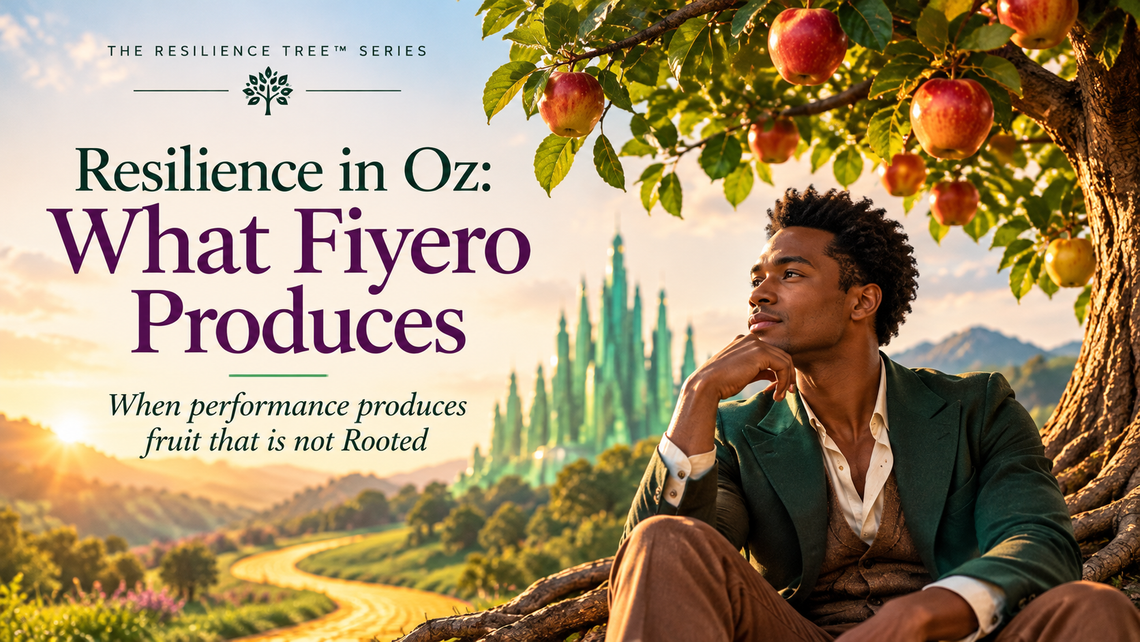
When performance produces fruit that is not Rooted
I’m continuing my journey through Wicked, this time looking at Fiyero through the lens of Fruit in the Resilience Tree™.
Fiyero enters the story looking like someone who has figured life out.
He is charming. Popular. Confident. Attractive. He seems comfortable in his own skin. He knows how to enter a room, capture attention, and move through the world with ease.
In other words, Fiyero knows how to produce a certain kind of Fruit.
The question is: What is feeding it?
🍎 Fruit: What We Produce
In the Resilience Tree™, Fruit represents Behavioral Resilience, what becomes visible through our choices and actions.
Our Fruit can be our work, leadership, creativity, contribution, relationships, decisions, and impact.
But Fruit isn’t simply about how much we produce.
It is also about what we choose to produce, what we choose not to produce, when we produce, when we stop, and whether what we produce is connected to what is rooted within us.
A tree doesn’t produce fruit in every season.
Neither do we.
And sometimes, producing more isn’t the goal.
Sometimes resilience looks like saying no.
Sometimes it looks like setting a boundary.
Sometimes it looks like stopping.
Sometimes it looks like recognizing that this is a season for restoration rather than production.
So when I think about Fiyero, I’m not simply asking, What does he produce?
I’m asking:
What happens when what we produce looks good on the outside but isn’t connected to what is Rooted within us?
🌿 When Performance Produces Fruit
Fiyero’s early persona is almost entirely built around performance.
- He knows how to be the person the room responds to.
- He knows how to be charming.
- He knows how to be admired.
- He knows how to be popular.
And he is very good at it.
But being good at something doesn’t necessarily mean it is our talent.
We can become competent at something because it was needed of us.
We can become exceptionally good at something because our family, workplace, culture, or circumstances rewarded it.
We can learn to produce something because we discovered that producing it gets us approval, access, security, recognition, or belonging.
Competence answers:
Can I do this well?
Talent leaves different clues.
- Do I feel drawn to it?
- Do I naturally notice things others don’t?
- Do I lose track of time doing it?
- Does it energize me?
- Do I find myself returning to it even when I’m tired?
- Do I want to keep learning and getting better at it?
These aren’t guarantees of talent. They’re clues.
And that distinction matters because we can spend years producing something simply because we became good at it.
That doesn’t necessarily mean it is the Fruit we are meant to keep producing.
🌱 From Performance to Alignment
This is where Fiyero’s story becomes particularly interesting.
His growth isn’t simply about changing what he does.
It’s about becoming more honest about why he does it and who he wants to be.
There is a difference between performing a role successfully and living in alignment.
Performance asks:
What will get me approval?
Alignment asks:
What reflects what I value?
Performance asks:
What does this environment expect from me?
Alignment asks:
What kind of person do I want to be?
And sometimes the most significant shift in our Fruit isn’t producing something new.
It’s recognizing that the Fruit we’ve been producing no longer reflects what is Rooted within us.
Alignment changes the Fruit.
🍎 Not All Fruit Is Meant to Be Produced
This is where I think we can get ourselves into trouble with leadership.
We celebrate production, more accomplishments, more opportunities, more responsibility, more visibility, more impact, more, more, more…
But trees don’t work that way.
There are seasons when they produce, there are seasons when they rest, there are seasons when they are pruned, there are seasons when what looks like nothing is happening above the ground while something important is happening below it.
So maybe the question isn’t always:
What more can I produce?
Maybe sometimes it is:
What am I no longer willing to produce?
Or:
Is this actually my season to produce?
Or even:
What would happen if I stopped producing what requires me to abandon my Roots?
Not every opportunity deserves your Fruit, not every request deserves your yes, not every expectation deserves your energy, and not every season calls for production.
🌿 The Fruit Check
So as I think about Fiyero’s journey, I’m left with a few questions for my own Resilience Tree, and perhaps yours:
- What am I producing right now?
- Is what I’m producing connected to what I value and who I am becoming?
- Am I producing this because I chose it, or because I’ve learned that this is what gets rewarded?
- Where have I developed competence in something that may not actually be a source of energy or talent for me?
- What am I continuing to produce simply because I’m good at it?
- What might I need to stop producing?
- Is this a season for Fruit, or a season for something else?
🌳 Let Your Fruit Reflect Your Roots
Fiyero’s story reminds me that we can become very skilled at producing a version of ourselves that the world knows how to reward.
But eventually, we may have to ask whether that Fruit is nourishing us.
You can be successful and still feel disconnected.
You can be productive and still be depleted.
You can be celebrated and still not recognize yourself.
You can be very good at something and still not be called to keep doing it.
The goal isn’t simply to produce more.
The goal is to produce intentionally.
To know when to say yes.
To know when to say no.
To know when to stop.
To recognize when it is not our season to produce.
And to allow what we produce to have some relationship to what is Rooted within us.
Don’t stop growing Fruit.
Stop growing Fruit that requires you to abandon your Roots. 🌳
Grow Your Resilience Tree™
The Living the Resilience Tree™ newsletter explores the everyday practices, relationships, strengths, and conditions that help people grow and thrive.
If this way of thinking about leadership resonates with you, I’d love to bring the Resilience Tree™ to your team or organization through a keynote, workshop, retreat, or facilitated experience.
You can also explore my book, The Resilience Tree: A Model for Women Leaders of Color and Those Who Support Them, and listen to the Living the Resilience Tree Podcast.
Until next time, keep tending your Resilience Tree™.