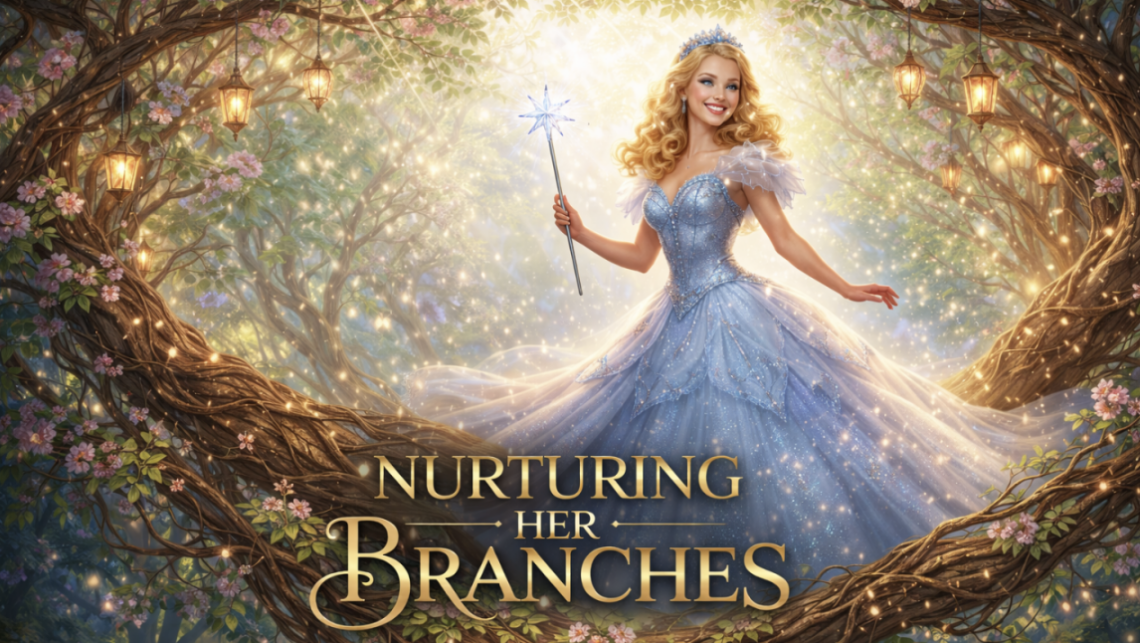
Today, I’m once again drawing inspiration from Wicked (the book turned musical turned two-part film adaptation), this time through the lens of its deuteragonist (a new word I learned that means the second most important character), Glinda Upland (formerly Galinda), portrayed in the films by Ariana Grande.
Often dismissed as surface-level, Glinda offers a surprisingly rich study in leadership. Her journey reveals a different kind of growth from Elphaba. One that unfolds in visibility, popularity, and social navigation.
Which makes her a powerful window into relational resilience or Branches.
🌳 The Resilience Tree Refresher
Welcome new readers!
The Resilience Tree is a framework I created to help leaders build sustainable growth:
- Roots – grounding, identity, and restoration
- Branches – relationships and relational pathways
- Environment – context & the systems / climates that shape growth
- Fruit – output, boundaries, agency, and integration
Last time, we explored the character of Elphaba through the component of Roots. Today, we explore Glinda’s ability to navigate connections based on her values and sense of identity which is a powerful illustration that what happens above the ground is supported by what is happening below ground and within.
Because some growth doesn’t happen in isolation. It happens in relationship.
🌸 BRANCHES: How Glinda Leads Through Relationships
Glinda is deeply relational from the beginning.
She is attuned to social dynamics, proximity, influence, and belonging. And while her growth is messy and imperfect, her story shows us how relationships shape leadership pathways.
Here are three ways Branches show up in her journey:
1. Using Influence to Open Doors
Glinda understands access early. She knows who holds power and how to get near it.
And while her motives aren’t always pure, she still does something that matters:
She uses proximity to influence outcomes.
Over time, we see her shift from social climbing to social bridging; using her relational awareness to create opportunities that wouldn’t exist otherwise.
Branch Archetypes: Glinda shows us Connector Branches, who introduce her to new opportunities, as well as Witness Branches, who see her potential and affirm her worth.
Takeaway: Sometimes branches begin imperfectly, but they still create opportunity.
Reflection Question: Where has someone’s access (even imperfect access) created a door for you?
2. Letting Relationships Change You
One of the most important relational shifts in Glinda’s story is her evolving connection with Elphaba.
What begins as convenience becomes something more complex. Proximity softens her. Exposure stretches her.
Relationships challenge her thinking and deepen her humanity. Through relationship, her worldview expands.
She begins to see beyond image. Beyond performance. Beyond approval.
This is what healthy branches do. They interrupt our certainty and deepen our humanity.
Branch Archetypes: Glinda’s Challenger Branches stretch her thinking, while her Witness Branches reflect the growth she has experienced along her journey.
Takeaway: The right relationships don’t just support us, they reshape us.
Reflection Question: Who has stretched your thinking simply by being close to you?
3. Carrying Influence Responsibly
As Glinda grows in visibility, so does her relational weight.
She becomes someone others look to. Someone whose words shape perception. Someone whose presence stabilizes rooms.
This is where we see the tension between relational leadership and responsibility:
- being liked vs. being honest,
- being celebrated vs. being truthful,
- being visible vs. being internally aligned.
Branches are not just about support. They are also about stewardship.
Branch archetypes: Glinda’s Challenger Branches continue to hold her accountable, while her Encourager Branches affirm her growth and help her navigate the responsibilities of her visibility.
Takeaway: Influence isn’t just about who stands with you; it’s about how you carry those who do.
Reflection Question: Where in your life are you learning that visibility comes with responsibility?
🌿 Why Branches Matter
In leadership spaces, we often overemphasize independence.
We celebrate the self-made. The resilient soloist. The one who “did it alone.”
But the truth is:
Most meaningful growth is relational.
We are shaped by:
- Who believes in us
- Who challenges us
- Who walks beside us
- Who reflects us back to ourselves
Branches are not accessories to leadership. They are infrastructure.
Because who stands with us often determines where we can go.
🌸 Closing Reflection
Not all growth happens underground.
Some growth happens in the open; In friendships, in colleagues, in roommates, in proximity. These become the people who shape how the world sees us and also how we see ourselves.
Glinda’s story reminds us that relationships are not just soft skills. They are structural forces in our development.
Branches are not about popularity. They are about pathways to our goals.
Branches support, challenge, stretch, and humanize us.
And…
We don’t outgrow our need for connection rather we grow into understanding it.
Elphaba teaches us how to stand. Glinda teaches us how to stay connected as we figure out where we stand.
If this resonated with you, share it with someone who has been a meaningful branch in your life.
And as always, tend your roots, honor your branches, and grow on purpose. 🌳
Grow Your Resilience Tree
Check out my book: Resilience Tree: A Model for Women Leaders of Color and Those Who Support Them Now Available on in paperback and audio:
Let’s grow together.

Written by Dr. Shauna T. Sobers, Creator of the Resilience Tree www.shaunatsobers.comDrafting assistance provided by OpenAI’s ChatGPT. The thoughts & stories are my own.