Understanding Relational Resilience
Have you ever stopped to think about the people who have shaped your leadership journey?
Not just the people whose names appear on your résumé or LinkedIn profile.
But the people who saw something in you before you saw it in yourself.
The mentor who challenged you to think bigger.
The colleague who spoke your name in rooms you weren’t in.
The friend who reminded you of your strengths after a difficult season.
The supervisor who opened a door.
Or perhaps the family member who quietly made sacrifices so you could pursue opportunities they never had.
Leadership often celebrates independence.
We admire the self-made leader.
The person who “worked their way to the top.”
But the longer I study resilience, the more convinced I become that no one grows alone.
Just as no tree grows without the support of an interconnected ecosystem, no leader develops without relationships that sustain, stretch, and strengthen them.
The Branches of the Resilience Tree™
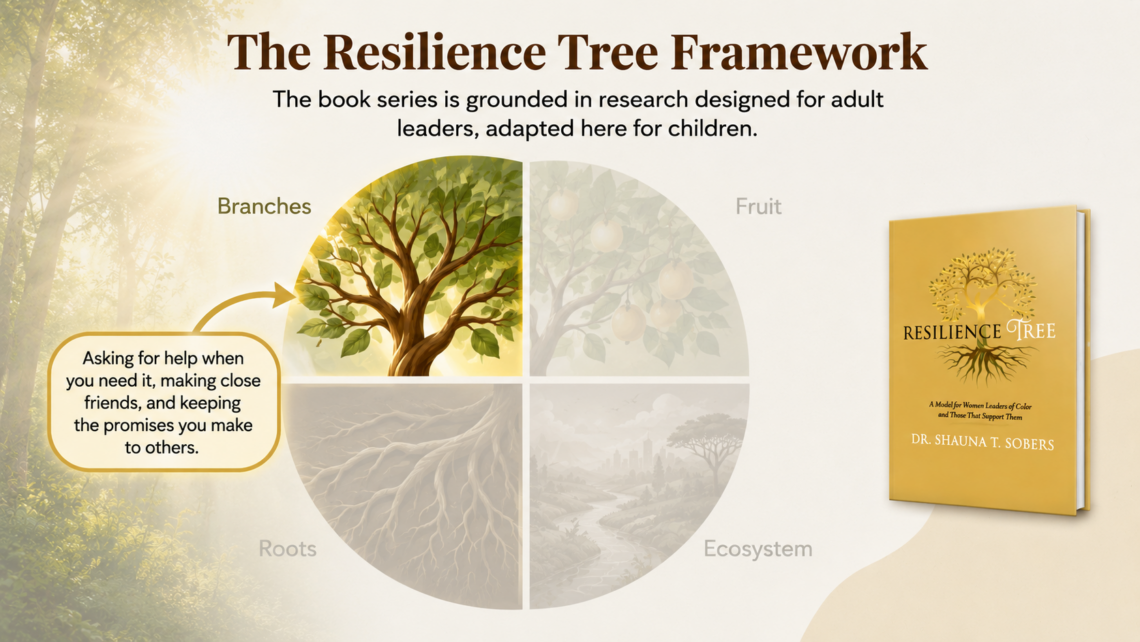
In the Resilience Tree™, branches represent Relational Resilience.
If roots keep us grounded, branches help us grow outward.
They connect us to light.
They create space for new growth.
They make it possible for fruit to emerge.
Relational resilience is about the people who contribute to our growth, not because they solve our problems, but because they help us navigate them.
These relationships come in many forms.
Mentors who share wisdom, champions who advocate for us, sponsors who create opportunities, peers who encourage us, friends who remind us to laugh, family members who provide stability, communities that affirm our identity.
Each relationship adds strength to the tree.
More Than Networking
When people hear the word “relationships,” many immediately think about networking.
Who should I connect with?
Whose business card should I collect?
Who can help me get my next opportunity?
Relational resilience is different.
Networking often asks, “Who can help me advance?”
Relational resilience asks, “Who helps me become?”
One focuses on transactions, the other focuses on transformation, the healthiest branches are built over time through trust, mutual investment, authenticity, and care.
They aren’t simply contacts.
They’re connections.
The Many Roles Our Branches Play
Not every Branch serves the same purpose.
Some people provide encouragement, others provide accountability.
Some challenge our thinking, others create psychological safety.
Some offer opportunities, others offer presence.
One lesson I’ve learned throughout my own journey is that expecting one person to meet every relational need almost always leads to disappointment.
Instead, resilience grows when we cultivate a diverse canopy of support.
Who tells you the truth when you need to hear it?
Who reminds you to rest?
Who celebrates your successes without competing with you?
Who helps you see possibilities you cannot yet see?
Different Branches provide different kinds of strength.
Relationships That Restore
In my research on resilience, one theme emerged again and again.
The relationships that matter most are not always the most visible.
Sometimes resilience comes from a monthly phone call with an old friend.
A text message that says, “I’m thinking about you.”
A mentor who checks in unexpectedly.
A community where you don’t have to explain your lived experiences because they already understand.
For many women leaders of color, identity-affirming communities become especially important branches.
These are spaces where your experiences are believed, your successes are celebrated, and your challenges are understood without requiring translation.
Those communities don’t just provide belonging.
They provide resilience.
Branches Require Care, Too
Healthy relationships don’t happen by accident.
Like branches on a tree, they require attention.
Time.
Intentionality.
Reciprocity.
Sometimes we become so focused on achieving that we unintentionally neglect the very relationships that sustain us.
We postpone lunch with a mentor.
We miss opportunities to reconnect with friends.
We assume the people who have always supported us will simply continue to be there.
But resilience reminds us that relationships, like trees, need tending.
Who have you been meaning to call?
Who has invested in you that deserves your gratitude?
Whose branch might need your support right now?
Because resilience is not only about receiving support.
It is also about becoming part of someone else’s resilience ecosystem.
Reflection Questions
As you think about your own branches, consider these questions:
- Who consistently helps me become the best version of myself?
- Who speaks my name in rooms where I’m not present?
- Where do I experience genuine belonging?
- Which relationships energize me, and which consistently drain me?
- How am I investing in the people who have invested in me?
Strong Branches are not measured by the number of people we know.
They are measured by the depth of trust we cultivate.
Living the Resilience Tree™
A resilience tree™cannot stretch toward the light without healthy branches.
Likewise, leaders cannot reach their fullest potential without meaningful relationships.
Relational resilience reminds us that asking for help is not weakness.
Receiving encouragement is not dependency.
And investing in others is not a distraction from leadership.
It is leadership.
Because resilient leaders understand that growth is rarely a solo journey.
It is cultivated through relationships that help us weather storms, celebrate harvests, and continue reaching toward new possibilities.
Next Time…
In the next edition of Living the Resilience Tree™, we’ll explore Behavioral Resilience through the lens of the tree’s fruit.
We’ll ask an important question:
What are you producing, and what is it costing you?
Until then, take a moment to look around.
Who holds up your branches?
And whose branches are you helping to strengthen?
Keep tending your Resilience Tree. 🌳

Helping leaders embrace their strengths, build resilience, and find ecosystems where they can thrive.
This reflection is part of my ongoing series exploring resilience, leadership, and the Resilience Tree™ framework. Read about it on my webpage – https://shaunatsobers.com/resiliencetree/
If it resonates, I’d love to hear your story in the comments or join the conversation in the Resilience Tree Grove: A women-centered space for reflection, growth, and connection – https://www.linkedin.com/groups/18348031/
Written by Dr. Shauna T. Sobers with drafting assistance provided by OpenAI’s ChatGpt. The thoughts & stories are my own.