Behavioral Resilience is More Than Productivity
This week, my body made a decision that my mind did not want to make. It slowed me down.
For weeks, I had been carrying a lot. Not just tasks but expectations, vision, and responsibility. The weight of making things happen.
I was preparing for an upcoming retreat. I was building my business. I was creating content. I was working through responsibilities at my full-time job. I was volunteering. I was pouring into spaces that matter deeply to me.
And somewhere along the way, I started believing the answer was to produce more. Just one more email, one more LinkedIn post, one more improvement to the presentation, one more thing checked off the list.
Because if I could just finish enough, maybe I would finally feel caught up, maybe I would finally feel enough.
But my body had a different message,
“Slow down, Pay attention, Something needs tending.”
Knowing and Doing Are Different Muscles
One of the humbling things about creating the Resilience Tree™ is that I get to practice what I teach.
I know the framework. I research about resilience. I coach leaders through sustainable leadership.
And yet, knowing what to do and doing it are two different muscles.
This week reminded me:
- Resilience is not about knowing the right answer.
- Resilience is about noticing when you need to practice it.
I had to admit something I did not want to admit… I was not okay.
For many of us, the automatic response to,
“How are you?”
is:
“I’m fine.”
Sometimes that response is true and sometimes it is a habit. It is a reflex and a way we keep moving without acknowledging what is happening underneath.
This week, breaking the cycle of “I’m fine” looked like reaching out (i.e. telling my therapist that I was struggling, asking my supervisor if I could work remotely, and letting people know I needed connection).
And that was not a failure of resilience.
That was resilience!
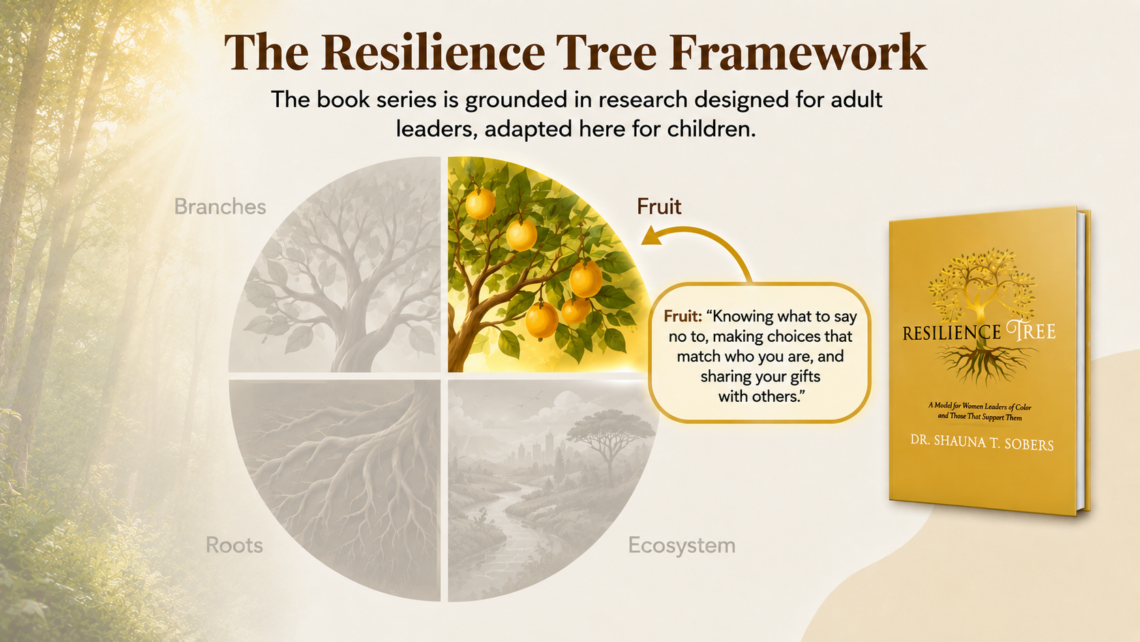
The Fruit of the Resilience Tree™: Behavioral Resilience
In the Resilience Tree™ component of Fruit represents Behavioral Resilience.
Fruit is what others see: Our accomplishments, our leadership, our contributions, our impact, our ability to create and produce.
And for many of us, especially high-achieving leaders, Fruit can become the place where we measure our worth.
The more we produce, the more valuable we feel.
The more we accomplish, the safer we feel.
But trees do not produce fruit endlessly without care.
Fruit requires Roots, Branches, and a healthy Ecosystem.
A Resilience Tree that produces Fruit while depleted may still look productive from the outside.
But the Fruit may not be as nourishing. It may be smaller, it may be shriveled, it may not have the abundance it could have had with proper tending.
And that is something I had to ask myself:
Am I producing fruit that is nourishing, or am I producing fruit because I am afraid to stop?
When Our Strengths Become Survival Strategies
As a CliftonStrengths® coach, I believe deeply in the power of our talents.
Our talents are gifts. They help us contribute, connect, create, and make an impact.
Our talent, like our Resilience Tree™, also need tending.
This week reminded me that even the things that make us successful can become overextended when we are not paying attention to what our Resilience Tree needs.
- My Achiever® reminds me there is always one more thing to accomplish.
- My Learner® encourages me to make it better, understand more, and keep growing.
- My Significance® wants my work to truly matter.
- My Harmony® reminds me to consider others and create connection.
- My Intellection® helps me process deeply and find meaning.
Individually, these are beautiful parts of who I am. Together, when I am not tending my Resilience Tree™, these same gifts can quietly lead me toward depletion.
A strength overused is not a weakness. It is a gift asking for attention.
- Sometimes my Achiever® needs to hear: “Rest. The work will still be there.”
- Sometimes my Learner® needs to hear: “You do not have to perfect everything before you share it.”
- Sometimes my Significance® needs to hear: “Your value is not measured only by your impact.”
- Sometimes my Harmony® needs to hear: “Your needs matter too.”
- Sometimes my Intellection® needs to hear: “You do not have to think your way through everything alone.”
These are beautiful parts of who I am. And even our greatest talents can become overextended if we don’t tend them.
The question is not: “How do I stop using my strengths?”
The question is: “How do I tend my strengths so they continue to help me flourish?”
Recognizing Our Depleting Clues
One of the things I have learned is that our trees give us clues.
In book 1 of the Resilience Tree™ children’s book series, Ruby’s Wonderful Roots, I invite the readers to learn to follow their Happy Clues the things that bring them joy, energy, and curiosity.
Adults need to notice the clues of the activities that make them happy as well as the clues of when they are depleted.
Some of my 🌟 happy clues include:
- Watching Disney or Hallmark movies
- Eating Chinese Food
- Dancing
- Talking about CliftonStrengths®
Some of my 🍂 depletion clues include:
- Arrive late to appointments or staying at work late.
- Providing a lot of detailed information.
- Letting my office, car, and/or my house get messy.
- Not making time for activities that restore me, like dancing or spending time with my mother.
These depletion clues are not character flaws. They are information. They are my Resilience Tree™communicating.
The question is not:
“How do I get rid of these behaviors?”
The question is:
“What is this behavior trying to tell me? and What will I do about it?”
Reaching Back for My Branches
One of the most meaningful parts of this week was realizing that some of the Branches I needed were not new. They were old.
I reached back to friends from my undergraduate years. People who knew me before my current titles, the books, the leadership roles, and the responsibilities.
And something powerful happened. We talked, laughed, caught up, and reminisced.
I had to think about the most important moments of my life that I wanted to share with them.
And in doing so, I remembered something important: Look how far I have come! I have so much for which to be grateful.
Sometimes our Branches help us remember parts of ourselves we have forgotten.
Just because we do not talk every day does not mean someone is no longer a branch.
Some Branches are: Witnesses, Believers, Challengers, and/or Connectors.
Branches do not have to be constantly touched to still be a Branch.
Living the Resilience Tree™
The Resilience Tree™ is not about becoming someone who never struggles.
It is about learning to recognize yourself sooner, noticing the clues, and asking for support before your body and/or activities have to shout.
This week, my Resilience Tree™ was asking for connection. Not another accomplishment. Not another completed task. Connection.
And I had to remember:
No thriving tree grows alone.
And that includes me. No matter what my negative self talk says!
🌳 This Week’s Resilience Tree™Check
This week, I needed to do my own Resilience Tree™ Check. Maybe you do, too. As you reflect, ask yourself the following questions:
🍎 Fruit: What am I producing right now? Is it nourishing me and others, or am I producing from depletion?
🌱 Roots: What restores me? What parts of myself do I need to reconnect with?
🌿 Branches: Who helps me remember who I am beyond what I accomplish?
☀️ Ecosystem: What conditions allow me to thrive instead of simply survive?
And then for fun, let’s also reflect on our clues:
🍂 Depleting Clues: What signals does my tree give me when it needs attention?
🌟 Happy Clues: What brings me back to myself?
Because resilience is not something we achieve. It is something we tend.
Keep tending your Resilience Tree. 🌳

Helping leaders embrace their strengths, build resilience, and find ecosystems where they can thrive.
This reflection is part of my ongoing series exploring resilience, leadership, and the Resilience Tree™ framework. Read about it on my webpage – https://shaunatsobers.com/resiliencetree/
If it resonates, I’d love to hear your story in the comments or join the conversation in the Resilience Tree Grove: A women-centered space for reflection, growth, and connection – https://www.linkedin.com/groups/18348031/
Written by Dr. Shauna T. Sobers with drafting assistance provided by OpenAI’s ChatGpt. The thoughts & stories are my own.