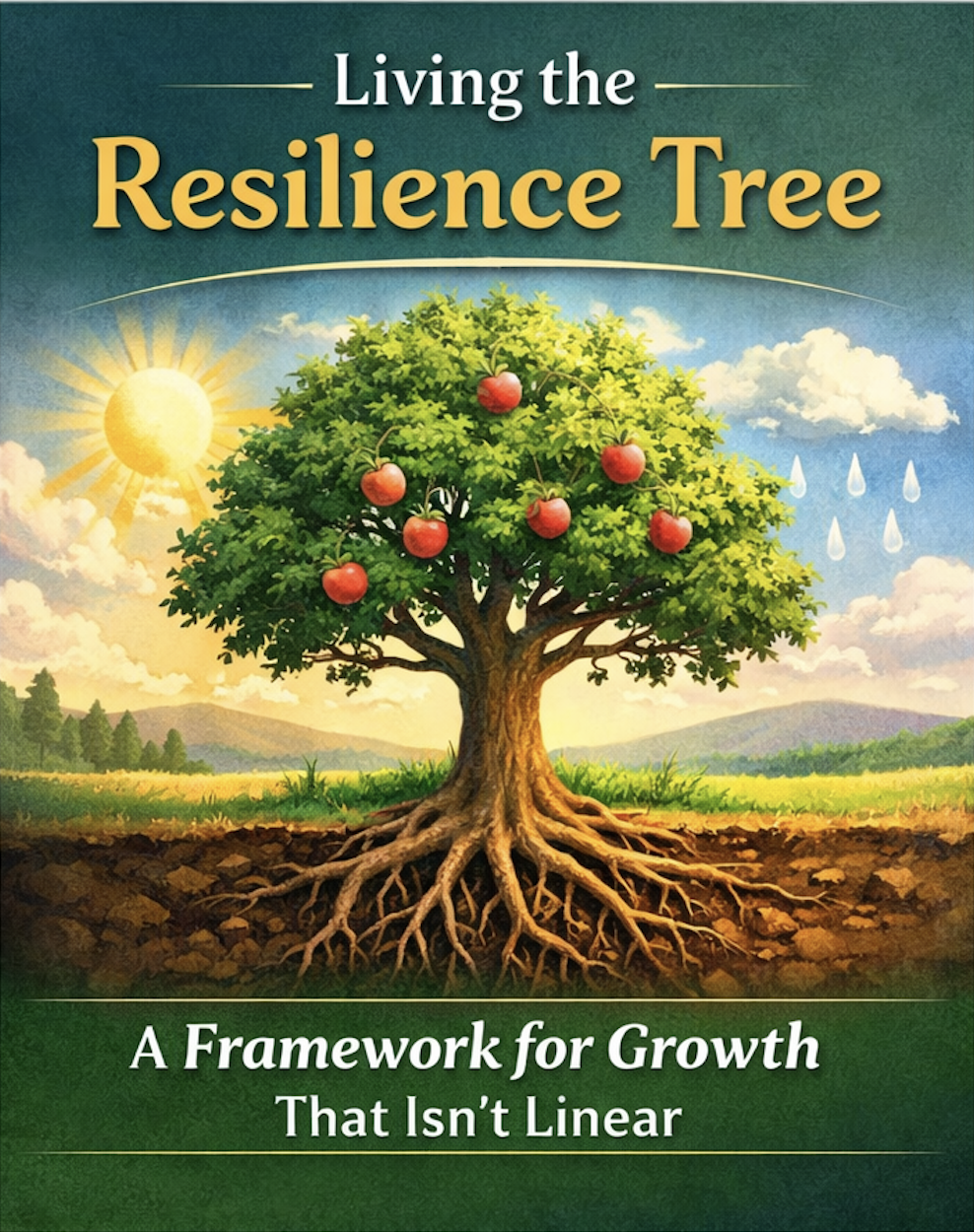
Why a Tree?
Because a tree is alive! It is shaped by its environment (its soil, climate, and care) yet it also contributes back, offering shade, producing fruit, and strengthening the ecosystem around it. It both depends on and adds to its surroundings.
That duality is what makes the tree such a powerful model for resilience.
Like a tree, we are constantly navigating what is given to us and what we choose to cultivate. Our growth is not linear. It is cyclical, adaptive, and deeply influenced by where we are planted.
And no two trees grow the same way.
There Is No “Right” Resilience Tree™
Every person has the same core components of resilience, but they are expressed differently depending on lived experiences, cultural context, upbringing, values, and access to opportunities.
Two people may both have strong support systems, but one leans on community while another draws strength from solitude. One may produce visible outcomes quickly, while another grows in quieter, less visible ways before anything external shows up.
The structure is shared. The expression is personal.
The Resilience Tree™: Four Interconnected Parts
The model consists of four parts:
- Roots (identity, grounding, restoration, and internal stability)
- Branches (relationships, opportunities, and pathways that extend outward)
- Fruit (output, contribution, integration, and meaning-making)
- Environment (the context in which everything exists)
Together, they form a living system; not a checklist.
Resilience Is About Capacity, Not Just Presence
It’s not enough to simply have these elements in your life.
What matters is whether they are strong enough to meet what you’re facing.
At any given time:
- Stressors increase or decrease
- Demands shift
- Your supports must adjust accordingly
Resilience becomes a question of capacity:
- Are your roots deep enough to hold you steady?
- Are your branches strong and diverse enough to support you?
- Is your fruit sustainable—or are you overextending yourself?
- Is your environment supporting your growth—or requiring constant compensation?
When demands exceed capacity for too long, something has to shift.
Sometimes that means strengthening your tree.
Sometimes that means re-evaluating where you’re planted.
A Living System, Not a Fixed State
The Resilience Tree is not something you “achieve.”
It is something you continuously tend.
It grows. It sheds. It regenerates. It adapts.
And like every tree, your growth will look different in every season.
Leadership Reflection
As you think about your own Resilience Tree™:
- Where am I currently over-relying on one part of my tree (Roots, Branches, or Fruit) at the expense of the others?
- What does “restoration” actually look like for me right now; and am I prioritizing it?
- Which relationships (Branches) are truly sustaining me, and which ones are depleting me?
- Is the “Fruit” I’m producing aligned with what actually matters to me, or just what’s expected of me?
- Where might my capacity need to grow to meet the current demands in my life and leadership?
In my next post, I’ll go deeper into one of the most misunderstood parts of this model: environment.
Because while we don’t fully control where we’re planted… we are not as stuck as we sometimes think.
Revising assistance provided by OpenAI’s ChatGPT. The thoughts & stories are my own.