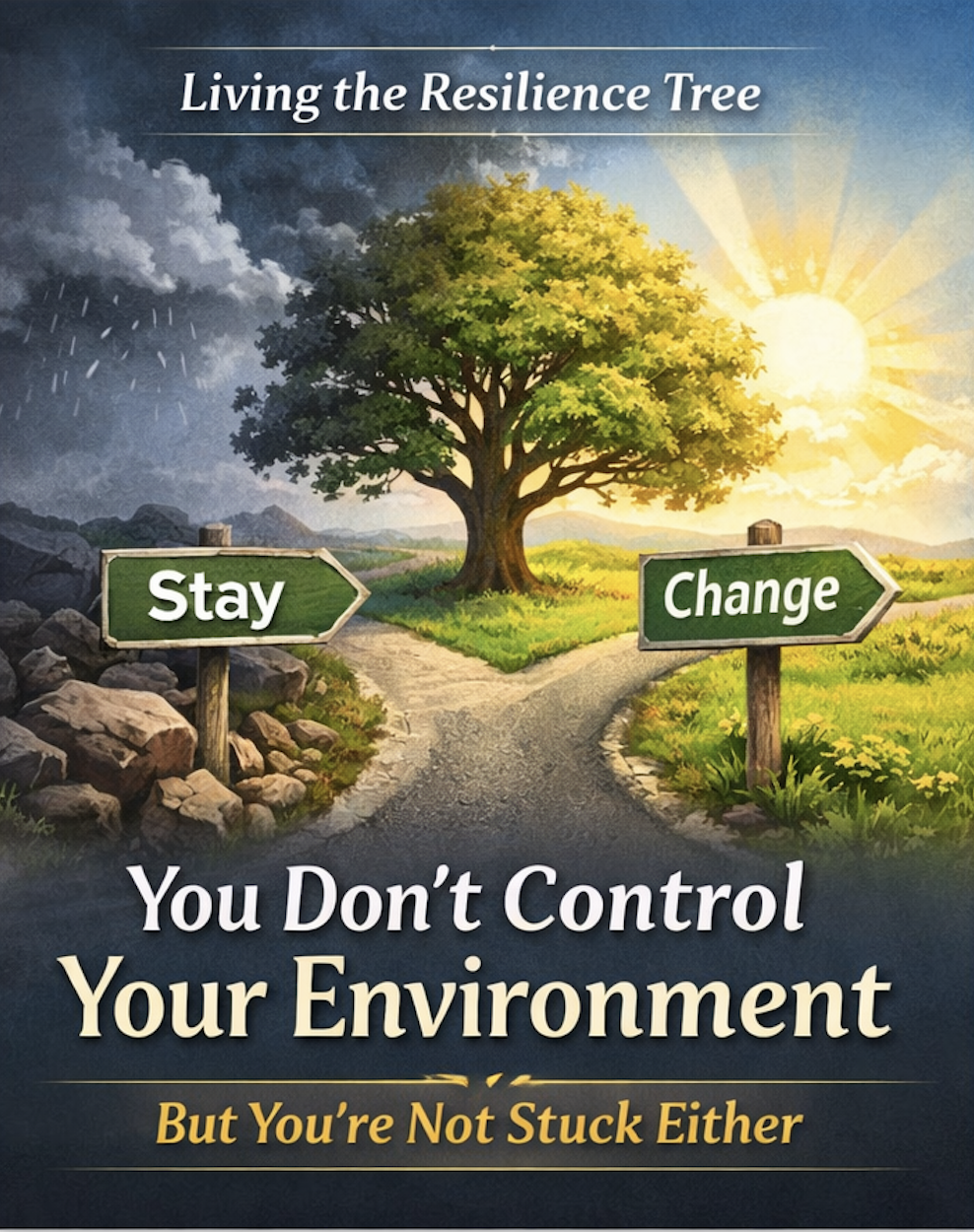
One of the most common questions I get about the Resilience Tree is this:
“If environment matters so much… how much control do we actually have over it?”
The answer is nuanced; and important.
Because how you understand this determines whether you feel empowered or stuck.
Two Types of Influence
Not all parts of the Resilience Tree operate the same way.
There are two types of influence:
1. What You Cultivate
- Roots (identity, restoration, grounding)
- Branches (relationships, opportunities)
- Fruit (output, contribution, meaning)
These are the areas you actively grow and develop over time.
They require intention, consistency, and awareness.
2. What You Navigate
- Environment (systems, culture, access, constraints, timing)
This is different.
You do not fully control your environment.
But it is not fixed either.
You don’t control your environment; you make decisions about your relationship to it.
Over time, you can:
- Seek new environments
- Leave ones that are not serving you
- Reposition yourself within them
- Advocate for change within them
- Decide what you will and will not tolerate
This is where resilience becomes both honest and empowering.
It acknowledges constraints without removing agency.
The Tension We Have to Hold
If we say people fully control their environment, we ignore real barriers and limitations.
If we say they have no control, we remove their ability to act.
The truth sits in the middle:
You have constrained agency.
And resilience is built in how you use it.
When Growth Requires More Than Endurance
There are seasons where the answer is to:
- Strengthen your roots
- Expand your branches
- Adjust your output
But there are also seasons where the most resilient decision is not to keep adapting.
It’s to change environments.
Because growth is not meant to happen in conditions that consistently deplete you.
Replanting Is a Form of Resilience
We don’t always choose where we start.
But over time, we do make decisions about:
- Where we stay
- What we tolerate
- When we leave
And sometimes, the strongest, most strategic move you can make is to replant yourself in a space that allows you to grow; not just survive.
Leadership Reflection
Consider your current environment:
- What aspects of my environment are truly outside of my control, and which ones have I been avoiding taking action on?
- Where am I adapting well, and where am I overcompensating at a cost to myself?
- What would it look like to reposition myself within my current environment instead of just enduring it?
- If nothing about my environment changed, what would I need to strengthen internally to remain effective?
- If I’m honest with myself, is this an environment I need to continue navigating, or one I need to begin preparing to leave?
Because resilience isn’t just about holding on.
It’s about knowing when to grow, when to adapt…
and when to move.
Revising assistance provided by OpenAI’s ChatGPT. The thoughts & stories are my own.